Showing posts with label window. Show all posts
Showing posts with label window. Show all posts
Monday, May 16, 2011
 Troubleshooting Your Window Air-Conditioner
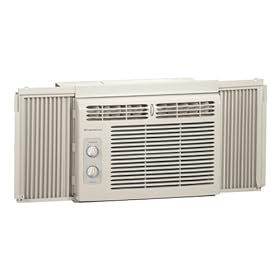
Window Mount Conditioners
If you use a window-mounted air-conditioner to keep your home cool, you know how powerful these little devices can be. Like a central AC system, a window air-conditioner has both indoor and outdoor components and when something goes wrong it can be difficult to determine where the problem lies.
Understanding Your Air-Conditioner
Inside the room you will find the evaporator coil, the part of the AC that gets cold, along with the fan or blower, the thermostat and controls, the filter and a plastic face panel.
Between the interior and exterior components is a panel that helps seal the unit in the window, preventing cool air from escaping and warm air from seeping in. This panel is usually expandable, so it is easy to customize the device to fit into your window, no matter what its size.
On the outside, you will find the air-conditioner’s compressor, the condenser and the fan that blows air across the condensing coil in order to cool it. Any moisture that collects inside the unit drains along the bottom and into a metal basin, which then drips to the outside of the house, through a hole or drain tube.
Now that you know the basics, it is time to take a look at some common in-room air-conditioner problems.
Water Dripping From the Front Panel
If you notice excess condensation or water dripping from the front of your air-conditioner, it almost always means that the drain pan is tilted incorrectly. Instead of guiding water toward the back of the unit and out of your home, the basin is allowing condensation to drain into the room.
Fortunately, correcting this problem is pretty simple. You just have to adjust the drain basin so that it tilts to the back of the unit and downward.
The Unit Cycles on and off Too Frequently
This generally indicates a problem with the unit’s thermostat or temperature sensor. Possible solutions include checking that the temperature sensor is positioned properly; near but not touching the evaporator coil. Move drapes and curtains away from the front panel. Remove leaves, branches and yard debris away from the exterior condenser. If none of these suggestions resolves the problem, call in a professional to service your AC unit, checking for refrigerant leaks and damaged components
Air-Conditioner Will Not Turn On
You could have a blown fuse, it could be a popped circuit breaker or the unit could be unplugged.
Obviously, you first want to make sure the air-conditioner is plugged in properly. If this fails to solve the problem you may have to replace the blown fuse or reset the breaker that connects to your AC’s power source.
Unit Keeps Blowing Fuses
If your AC is constantly popping the circuit breaker or blowing out fuses it usually means that it is hooked up to an inadequate power source.
Most residential window units require at least 120 volts of electricity operating off a 15amp circuit. You will need more power if your AC is larger. Run the air-conditioner from its own dedicated circuit; at least 20 amps, in order to correct the problem.
Related Air Conditioning Information from Horizon Services...
Tuesday, May 4, 2010
Put Up Curtains to Bring Down Heating & Air Conditioning Costs!

In these tough economic times, we’re all looking for ways to tighten our budgets and save a little money. At home, one of the most effective ways to cut your energy costs is also one of the least expensive: insulated curtains.
Insulated curtains keep drafts out and cut down on heat exchange -- the process by which heated or cooled air leaves your home and warm or cold air comes in. This is the number one cause of energy loss in most homes. By reducing heat exchange, insulated curtains help keep the temperature inside your home constant without taxing your heating and air conditioning system. You’ll save on electricity usage and monthly utility costs.
There are various types of insulated curtains, each with a different degree of protection against warm or cool air loss. However, most include several layers meant to help regulate your home’s temperature. There’s an outer decorative layer to match the décor in your room, an inner lining, a layer of high-density foam that blocks sound and heat exchange, a reflective vapor barrier that prevents moisture build-up, and another reflective layer that holds air in the room. Many insulated curtains also have a magnetic strip sewn into the edge seams that help form a tighter seal around the window, adding another layer of protection against heat exchange.
There are many benefits to using insulated curtains.
In warm weather, keeping insulated curtains closed during the day blocks the sun’s heat. You’ll use less air conditioning because you’ll be letting less heat into the house. In winter, keeping the curtains open during the day will let in heat from the sun. Closing curtains at night traps that heat in your home, and you’ll be able to turn the thermostat down and use less heating. Both of these methods reduce the strain on your home’s heating and air conditioning system, saving significant energy and money.
Another benefit of insulated curtains is that they provide superior soundproofing for your home. Outside noises stay out, and inside noises stay in. Though they probably won’t prevent the neighbor’s blasting stereo noise from entering your home, for annoying ambient sounds like lawn mowers, barking dogs and loud passing vehicles they do make a great addition. You’ll find insulated curtains especially useful in bedrooms or kids’ rooms where a little extra quiet tends to come in very handy.
Insulated curtains come in a variety of patterns, fabrics, colors, thicknesses, and durability. They can be easily purchased at most home goods, discount or department stores or from online specialty shops. With so many options it’s easy to find a style that’s sure to suit your taste and room décor. Most can be hung from any standard curtain rod, though heavier curtains may call for a sturdier hanging device. Taking care of insulated curtains is no more difficult than caring for regular window treatments. Regular light vacuuming will keep them free of dust and looking like new. Tough stains wear may require occasional dry cleaning.
For significant energy savings without the substantial investment of replacing or upgrading your home’s heating and air conditioning system, give insulated curtains a try. You'll have it made in the shade!
Related Information from Horizon Services...
Subscribe to:
Posts (Atom)
Subscribe!


 Posts
All Comments
Posts
All Comments
My Blog List


AddThis

Keystone Partner

Horizon Services is a Keystone Partner of Philadelphia Union, Major League Soccer Team


