Showing posts with label air condtioner. Show all posts
Showing posts with label air condtioner. Show all posts
Monday, May 16, 2011
 Troubleshooting Your Window Air-Conditioner
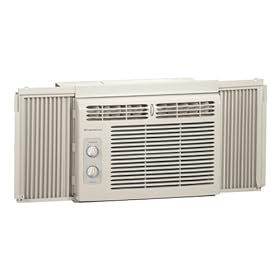
Window Mount Conditioners
If you use a window-mounted air-conditioner to keep your home cool, you know how powerful these little devices can be. Like a central AC system, a window air-conditioner has both indoor and outdoor components and when something goes wrong it can be difficult to determine where the problem lies.
Understanding Your Air-Conditioner
Inside the room you will find the evaporator coil, the part of the AC that gets cold, along with the fan or blower, the thermostat and controls, the filter and a plastic face panel.
Between the interior and exterior components is a panel that helps seal the unit in the window, preventing cool air from escaping and warm air from seeping in. This panel is usually expandable, so it is easy to customize the device to fit into your window, no matter what its size.
On the outside, you will find the air-conditioner’s compressor, the condenser and the fan that blows air across the condensing coil in order to cool it. Any moisture that collects inside the unit drains along the bottom and into a metal basin, which then drips to the outside of the house, through a hole or drain tube.
Now that you know the basics, it is time to take a look at some common in-room air-conditioner problems.
Water Dripping From the Front Panel
If you notice excess condensation or water dripping from the front of your air-conditioner, it almost always means that the drain pan is tilted incorrectly. Instead of guiding water toward the back of the unit and out of your home, the basin is allowing condensation to drain into the room.
Fortunately, correcting this problem is pretty simple. You just have to adjust the drain basin so that it tilts to the back of the unit and downward.
The Unit Cycles on and off Too Frequently
This generally indicates a problem with the unit’s thermostat or temperature sensor. Possible solutions include checking that the temperature sensor is positioned properly; near but not touching the evaporator coil. Move drapes and curtains away from the front panel. Remove leaves, branches and yard debris away from the exterior condenser. If none of these suggestions resolves the problem, call in a professional to service your AC unit, checking for refrigerant leaks and damaged components
Air-Conditioner Will Not Turn On
You could have a blown fuse, it could be a popped circuit breaker or the unit could be unplugged.
Obviously, you first want to make sure the air-conditioner is plugged in properly. If this fails to solve the problem you may have to replace the blown fuse or reset the breaker that connects to your AC’s power source.
Unit Keeps Blowing Fuses
If your AC is constantly popping the circuit breaker or blowing out fuses it usually means that it is hooked up to an inadequate power source.
Most residential window units require at least 120 volts of electricity operating off a 15amp circuit. You will need more power if your AC is larger. Run the air-conditioner from its own dedicated circuit; at least 20 amps, in order to correct the problem.
Related Air Conditioning Information from Horizon Services...
Wednesday, August 25, 2010
BTUs and Your Air Conditioner
 A British Thermal Unit -- or BTU -- is the measure of an air conditioner’s power output and cooling capability. Normal BTU range for most air conditioners goes from around 5000 for a small window unit to 30,000 or more for a central AC system. BTU output is directly related to the size and cost of a unit—lower BTU means less power and lower cost, higher BTU means more power and higher cost. When you’re shopping for a new air conditioner, pay special attention to BTU because this is the best indicator of whether the unit is powerful enough to meet your needs.
What is a BTU?
If you’re talking about air conditioners, BTU describes the power capacity of a specific unit. Generally, BTU output corresponds to the size of the space an AC can cool—a unit with more BTU can cool a larger room. About 20 BTUs are needed for each square foot of space in a room or home. Other things to consider are the height of ceilings, size and number of windows, and amount of insulation.
Still, BTU is a fairly accurate indicator of cooling capability, though it usually makes sense to adjust down. For example, if your living room is 10 feet by 15 feet and has a total area of 150 square feet, you’d multiply that by 20 BTUs to get 3000. Therefore, you’d need an air conditioner with at least 3000 BTUs to effectively cool your living room. However, when you take into account the other factors that impact the space—like cathedral ceilings, large windows, or an unusually warm climate—you may find that 3000 BTUs are not enough to keep you cool. In that case, it’s obviously best to choose a unit with higher BTU.
BTU Range
There’s a wide range of BTU outputs available in both commercial and residential air conditioners. Most residential units average 5000 to 30,000 BTUs. 12,000 BTUs equals one ton of air; some units are marked with a measurement in tons rather than BTU. A “2-ton” AC, for instance, means that the unit has an output of 24,000 BTUs.
Portable air conditioners average about 5000 to 12,000 BTUs. Wall and window units can reach upwards of 24,000 BTUs at the high end. Mini split systems range from 9000 to 24,000 BTUs, while multi-split systems and central air conditioners can put out 30,000 BTUs or more. Industrial air conditioning systems frequently have BTU output significantly higher than 30,000.
Not only will BTU tell you how much room an air conditioner can cool, but it can also give you an idea of how much you’ll have to pay to run it. The more BTUs a unit uses, the more it will cost to operate. To save money on utilities, look for air conditioners with a high Seasonal Energy Efficiency Rating (or SEER). Additional features like programmable thermostats, timers, fans, and power-saving settings can reduce strain on your system, boost efficiency, and lower your energy costs while still keeping your home cool.
Related Air Conditioning Information from Horizon Services...
Subscribe to:
Posts (Atom)
Subscribe!


 Posts
All Comments
Posts
All Comments
My Blog List


AddThis

Keystone Partner

Horizon Services is a Keystone Partner of Philadelphia Union, Major League Soccer Team


